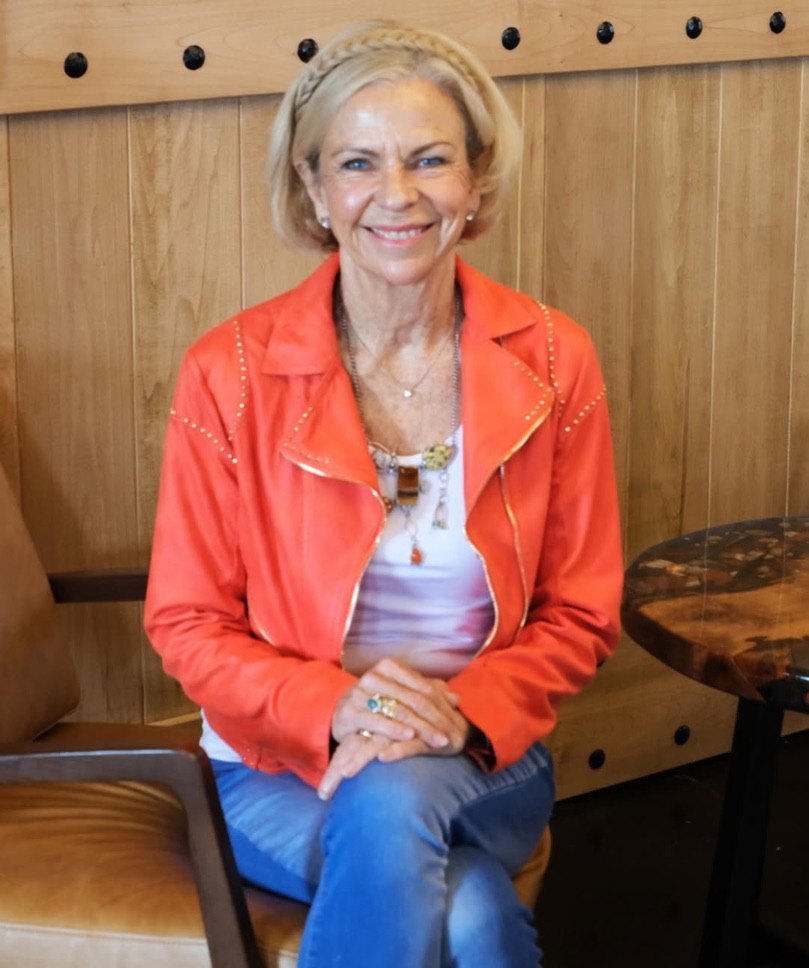
(And other things I learned from a three-year-old and a turbulent flight)
Years ago, I had a goddaughter called Isabella who was three years old and, in my entirely unbiased opinion, perfect. Every time I arrived at her house, I would call out 'YOOO HOOO!' from the doorway, and I would hear the sound of small feet thundering toward me from somewhere deep inside the house. Then she'd appear, face lit up, arms wide open, and we'd run toward each other like the world's most enthusiastic slow-motion movie scene.
If you have never had a small child run at you with unconditional, full-body joy, please, find one immediately. (With the parents' permission, obviously. Don't be weird about it.)
One Sunday, we went for a walk on a gorgeous day, the kind of day where the sun is doing everything right and the world smells like it just had a shower. I was so happy I started singing. I should tell you: I am not a good singer. Isabella, to her enormous credit, didn't care even slightly. We tangoed, we waltzed, we made up terrible songs. We laughed until we couldn't breathe.
About half an hour later, I noticed Isabella ahead of me on the path, completely alone, dancing and singing to herself: 'It's a bootiful day to be ouside! It's a bootiful day to be alive!' She had absorbed it. Without being taught. Without being told. Just from being in the presence of joy.
THE RESEARCH SAYS: New research from the Big Joy Project at UC Berkeley found that even tiny 'micro-moments' of joy, lasting seconds, not hours, measurably improve immune function, reduce cortisol, and rewire neural pathways toward resilience over time. Joy is not a destination. It's a practice, available in any moment.
, Harvard T.H. Chan School of Public Health / UC Berkeley Greater Good Science Center, 2025
The next day I was on a plane, as I usually am, being a person whose entire career takes place in airplanes and hotel ballrooms, and the weather in Dallas was gray and heavy and the sort of dull that makes you wonder if the sun has simply decided to retire.
And then we broke through the clouds. Suddenly: electric blue sky. Blinding light. Not a cloud in sight, because we were above them.
It is always sunny above the clouds. Always. Without exception.
I've thought about that moment hundreds of times since. Because it seems obvious, of course the sun is still up there, it hasn't gone anywhere, and yet when we're in the middle of a difficult stretch, when the gray has settled in and won't seem to budge, it is genuinely easy to forget. The sun feels absent. The warmth feels like a distant memory. And our brain, bless it, is absolutely convinced that this time, this time, it's different. (It is not different. The sun is still there.)
What Your Brain Does with Clouds
Here's the thing about difficult periods, and I'm talking about everything from a bad quarter at work to a relationship that's strained, a health scare, a team that's lost its spark, or a period in your own head that feels dark and relentless, your brain, when it's stressed, does something called 'negative forecasting.' It takes the current gray and projects it forward indefinitely. 'Things will always be like this.' 'I will always feel like this.' 'This will never get better.'
It is, to put it gently, lying to you. The neuroscience of resilience is now clear: the brain is neuroplastic, it can and does change, and the single most powerful thing you can do in a difficult period is to actively look for evidence that contradicts the 'it's always gray' story.
THE RESEARCH SAYS: A 2025 study published in PubMed found that habitual positive emotional states, including cultivated joy and gratitude, measurably promote brain health, reduce neuroinflammation, and are associated with significantly lower rates of depression, anxiety, and cognitive decline. The brain you practice most becomes the brain you have.
, PubMed / Healthy Happiness: The Effect of Happiness in Promoting Brain Health, 2025
In practical terms, for both your personal life and your professional one, this means: when you're in a gray patch, with your team, with a project, with yourself, your job is not to pretend the clouds aren't there. (They are there. Acknowledge them.) Your job is to remember, and to remind the people around you, that it is always sunny above the clouds. The sun has not retired. The warmth is not gone forever. This too shall pass, and while you're waiting, you can still choose to look for the light.
What to Actually Do When the Clouds Roll In
- Tell yourself, and your team, 'This is hard right now, and it won't be hard forever.' Both parts matter.
- Look for one thing that's working. Just one. The brain will try to dismiss it. Don't let it.
- Find your Isabella moment. Something tiny that brings uncomplicated joy, a walk, a ridiculous song, a child, a dog, a really excellent coffee. Let it matter.
- Remember: the sun is not punishing you by hiding behind a cloud. It's just a cloud. Clouds move.
"It's always sunny above the clouds.
You just have to remember it's there.", Amanda Gore
Isabella is grown up now, which is frankly hard to believe and a little rude of her. But I still hear her little voice when I hit a dark patch: 'It's a bootiful day to be alive!' And she's right. Even on the gray ones. Especially on the gray ones. The sun is always up there. Just reach a little higher.