I ask this question from every stage I stand on, all over the world. Think about your best boss, your favorite teacher, your most beloved relative. Really think about them. Picture their face. Remember how you felt in their presence.
What did they all have in common?
Every single time, without fail, in every country and every industry, people share the same answer. You felt safe around them. You felt like you mattered. You felt like they genuinely believed in you, even on the days when you weren’t so sure about yourself.
They made you feel extraordinary. And because they did, you were.
That is not a coincidence. That is neuroscience. And it is the single most important thing any leader, parent, teacher or human being can understand.
The Thing Nobody Is Talking About
Right now, organizations are spending billions on leadership development, change programs, productivity tools, wellness apps and culture initiatives. And a lot of it isn’t working. Not because the ideas are bad, but because they are missing the one variable that makes everything else possible.
Safety. Psychological safety.
The feeling that you can speak up, make a mistake, disagree with your boss, try something new, and still belong. Still be valued. Still have a job on Monday morning.
Here is what the neuroscience shows us. When people feel threatened, when they don’t feel safe, the brain’s threat detection center fires up and shuts down access to the prefrontal cortex. That’s the part of the brain responsible for creativity, complex thinking, collaboration and sound decision making. In other words, the very things every organization is desperately trying to get more of.
You simply cannot train your way around a person’s nervous system. You cannot mandate creativity in a culture of fear, no matter how beautifully the values are printed on the wall in reception.
But here is the good news, and I genuinely love sharing this because it changes everything when people really let it in. The reverse is equally true.
When people feel safe, they change. They become creative. They collaborate. They perform. And they get results that take your breath away.
This is not wishful thinking. This is biology.
People Change at the Speed of Safety
People change at the speed of safety. Not at the speed of a new KPI framework, not at the speed of a restructure, and definitely not at the speed of a strongly worded all-staff email.
We have spent decades trying to drive change through pressure, incentives and the gentle threat of consequences. And we keep wondering why it doesn’t stick. Why people nod enthusiastically in the meeting and then drift quietly back to the old way the moment they’re back at their desks.
It doesn’t stick because it’s coming from the outside. Real change, the kind that actually shows up in your quarterly results and your staff retention numbers and your customer satisfaction scores, comes from the inside. And it only happens when people feel safe enough to let it in.
The leaders who truly understand this are the ones building organizations that everyone wants to work for. Their people go above and beyond not because they are told to, but because they genuinely want to. Because somebody made them feel like they were worth going above and beyond for.
How Do People Feel After Five Minutes With You?
Here is a question worth sitting with, and I say this with great warmth because I have had to sit with it myself.
How do people feel after they have spent five minutes with you? Not what do they think of your strategy or your ideas. How do they feel? Do they feel energized or drained? Seen or invisible? Valued or merely tolerated? Safe enough to tell you what is actually going on, or careful enough to tell you only what they think you want to hear?
Because here is the thing that will either shift everything for you or sit uncomfortably until you are ready for it.
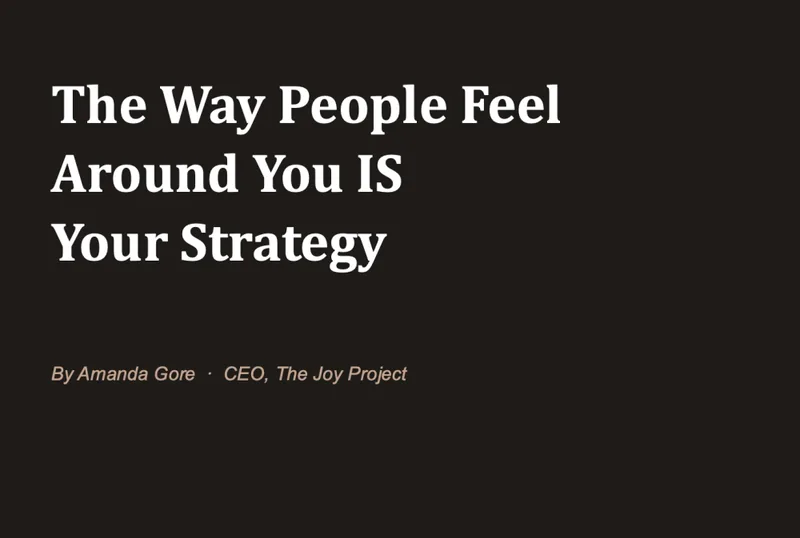
The way people feel around you IS your strategy.
It is not a soft add-on. It is not a nice-to-have for when business is going beautifully. It is the strategy. Your culture, your performance, your innovation, your ability to retain wonderful people and attract more of them, all of it flows from this single source.
If people feel afraid around you, you are getting a fraction of what they are truly capable of. If they feel safe, seen and genuinely valued, you tap into something most leaders never access. The discretionary effort. The idea someone has at midnight that they actually bother to share with you. The honest feedback that saves you from a costly mistake. The loyalty that no salary package alone can buy.
The Leader Nobody Ever Forgets
Go back to the person you pictured at the very beginning. Were they the toughest person you ever worked for? Maybe. Were they the smartest? Perhaps. The most technically brilliant? Not necessarily.
What they were was consistent. Consistently interested in you as a human being, not just as a performer. Consistently believing you could do more than you thought possible. Consistently creating a space where you felt safe enough to actually try.
That is not luck and it is not a personality type. It is a skill. And like every skill, it can be learned.
The leaders I work with who create the most extraordinary results are not superhuman. They have simply made a decision, a deliberate, daily, sometimes difficult decision, to make the people around them feel extraordinary. And what happens next is really something to witness.
People stop just turning up. They start showing up, all of them, whole-hearted, switched on, bringing everything they have. Not because it was demanded but because someone created the conditions that made it feel both safe and worthwhile.
Help people feel extraordinary and they will be.
What This Actually Looks Like
It starts with something so deceptively simple that people sometimes roll their eyes when I say it. Please stay with me on this.
It starts with noticing people. Really noticing them. Not a perfunctory good morning as you stride past with your coffee. A genuine moment of actual human connection. Eye contact that lasts more than a second. A question you stay present long enough to hear the answer to. The quiet acknowledgment that another human being exists in your orbit and you are genuinely glad they do.
It starts with how you walk into a room, because the emotional temperature of a team rises or falls with the mood of its leader long before a single word is spoken. Every morning you are setting a tone. The question is whether it is happening consciously or by accident.
It starts with choosing, deliberately and repeatedly, to make people feel safe enough to do their best work. That is not a poster slogan. That is a leadership operating system. And when leaders build this skill, the results are not soft and fluffy. They show up in the numbers.
Joy Is Not What You Think It Is
When I talk about joy in the context of leadership, people sometimes assume I mean something vaguely nice. Be cheerful. Send more positive emails. Bring snacks.
That is not joy. That is decoration.
Joy, in the context of what I call Amanda Gore JQ®, is a neurological state. It is what happens in the brain and body when a person feels genuinely connected, purposeful, valued and safe. It is the state in which human beings are most capable, most resilient, most creative and most productive. The research on this is not new and it is not ambiguous.
Joy is not the opposite of high performance. Joy IS high performance.
The leaders who understand this and build the skills to create genuinely joyful, safe and connected environments are not the soft ones. They are the strongest, most sophisticated leaders in any room. Because creating fear requires no skill at all. Anyone can do that. It works briefly, badly, and with an enormous long-term cost to culture, performance and people.
Creating safety? Creating an environment where people feel so seen and valued that they choose to bring their whole heart to the work? That takes real courage, real skill, and a decision to lead in a way that actually changes people.
The Question Worth Asking Yourself
The person you pictured at the very beginning of this article, your best boss, your favorite teacher, that person who believed in you when you weren’t sure you deserved it, they probably couldn’t have explained what they were doing. They just did it. Instinctively. Naturally. Because it was simply who they were.
You don’t have to leave it to instinct. This is learnable. This is measurable. And the results show up not just in how people feel but in what they deliver, who they become, and what they make possible for the people around them.
The only question really worth asking is this. What kind of leader do you want to be remembered as?
The kind people survived? Or the kind that made them feel so safe, so seen and so genuinely valued that they became more than they ever thought possible?
Because that is the leader nobody ever forgets. And that is exactly what the world needs more of right now.